
Wedding Dress Styles Chart: A-line, Mermaid, Ball Gown & Every Silhouette, Explained
Every wedding dress ever made is a variation on a dozen or so silhouettes. Knowing those silhouettes — being able to name them, recognize them on a hanger, and imagine them on your own body — is one of the most useful things a bride can do before her first appointment. This chart is designed to do exactly that.
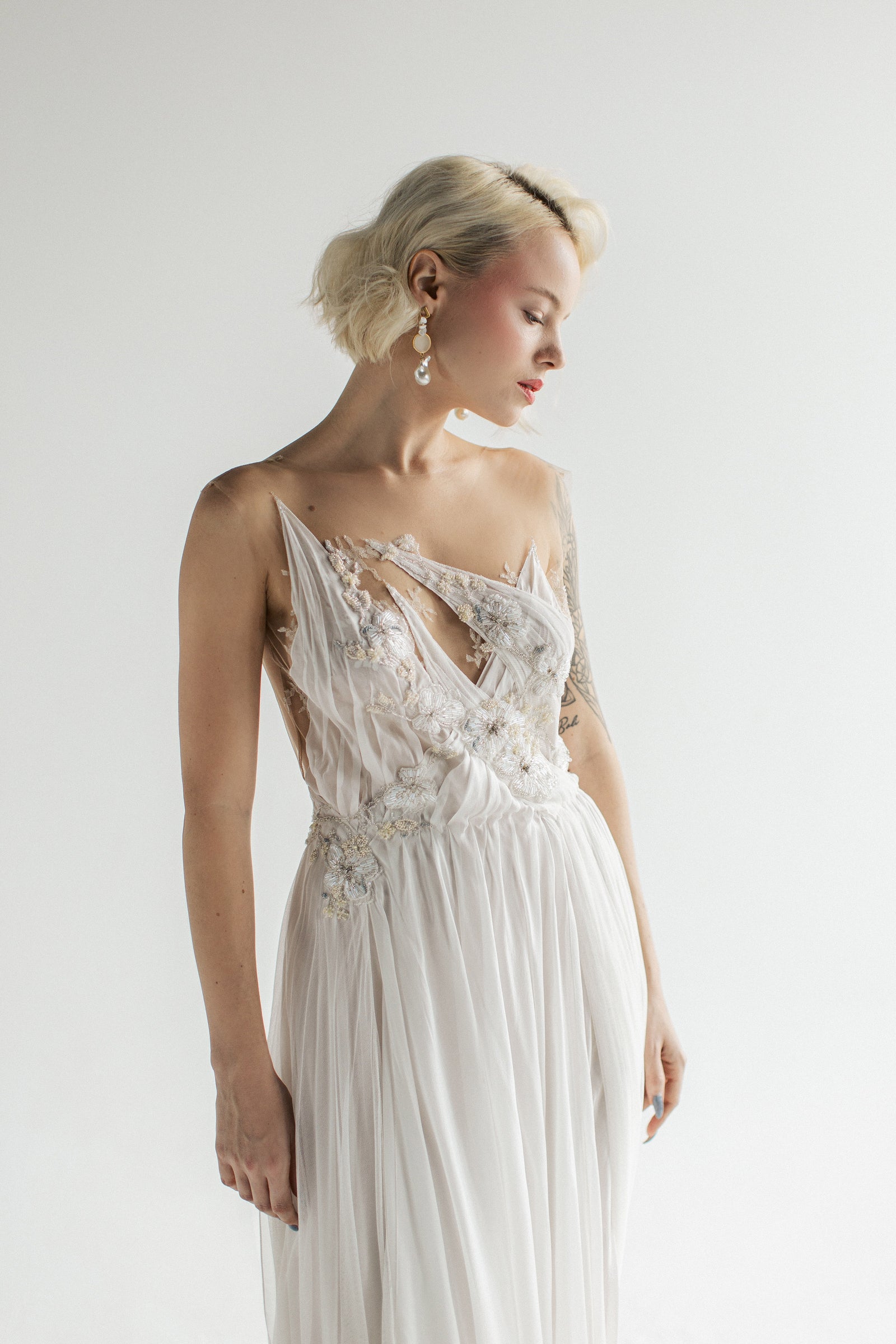
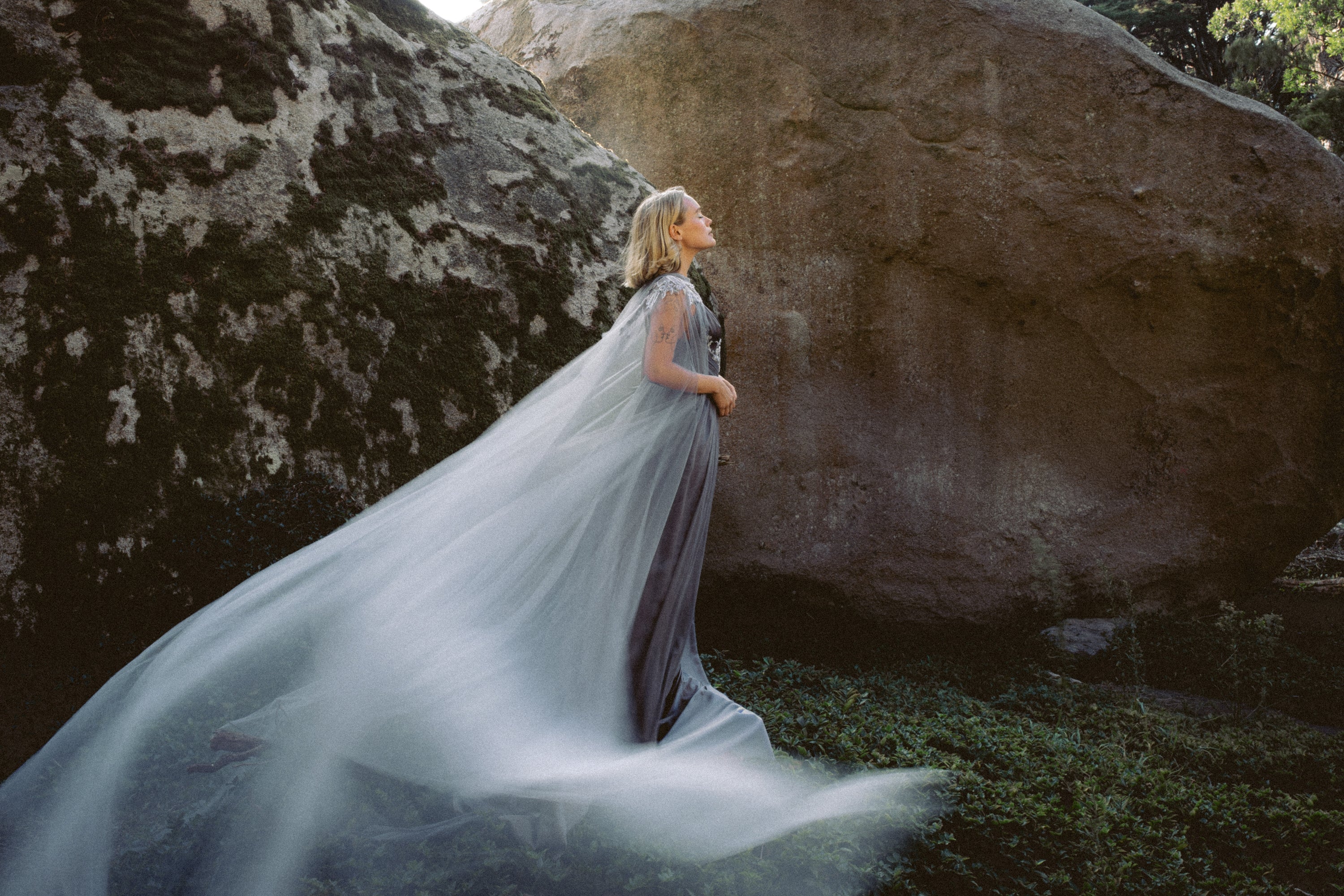
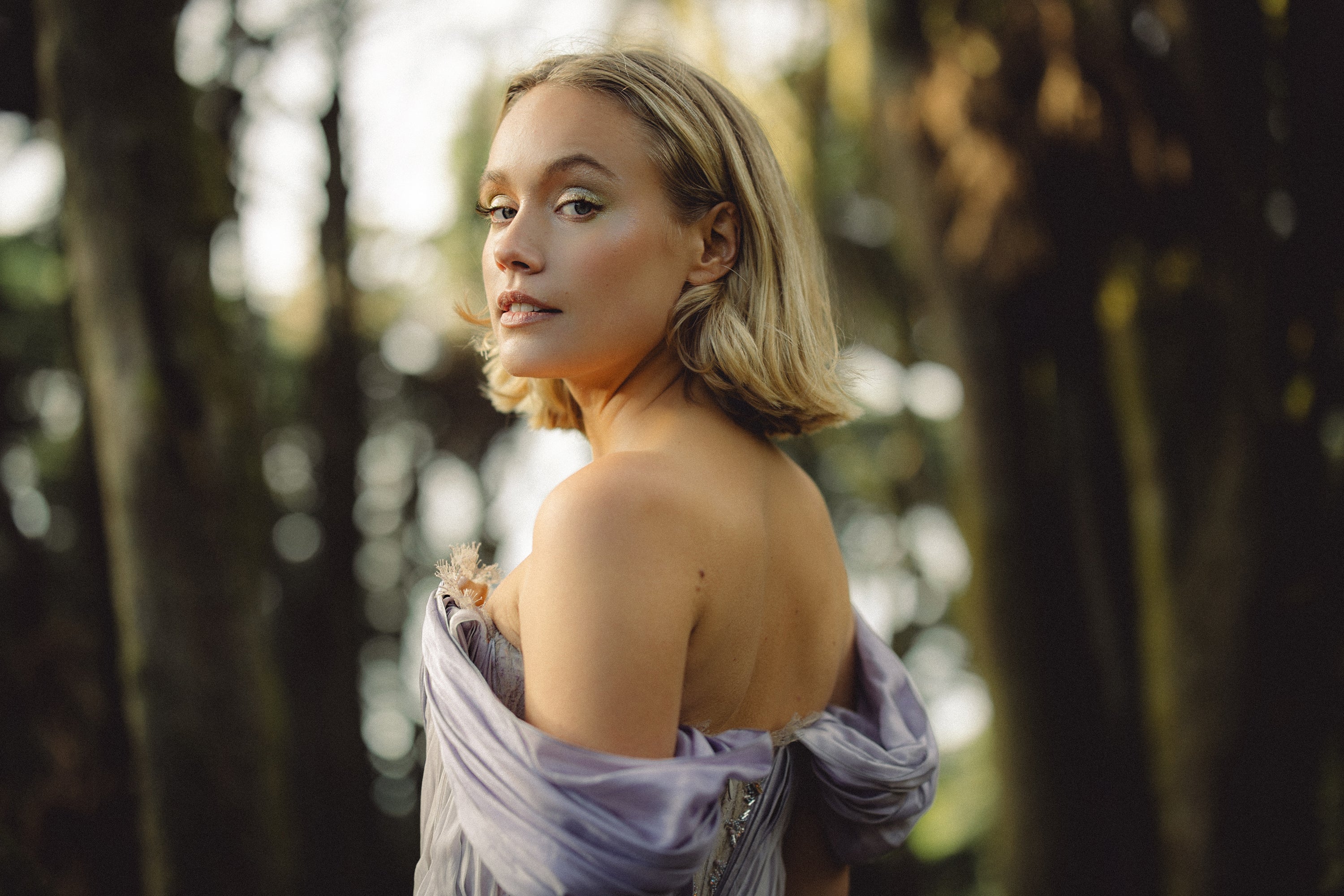
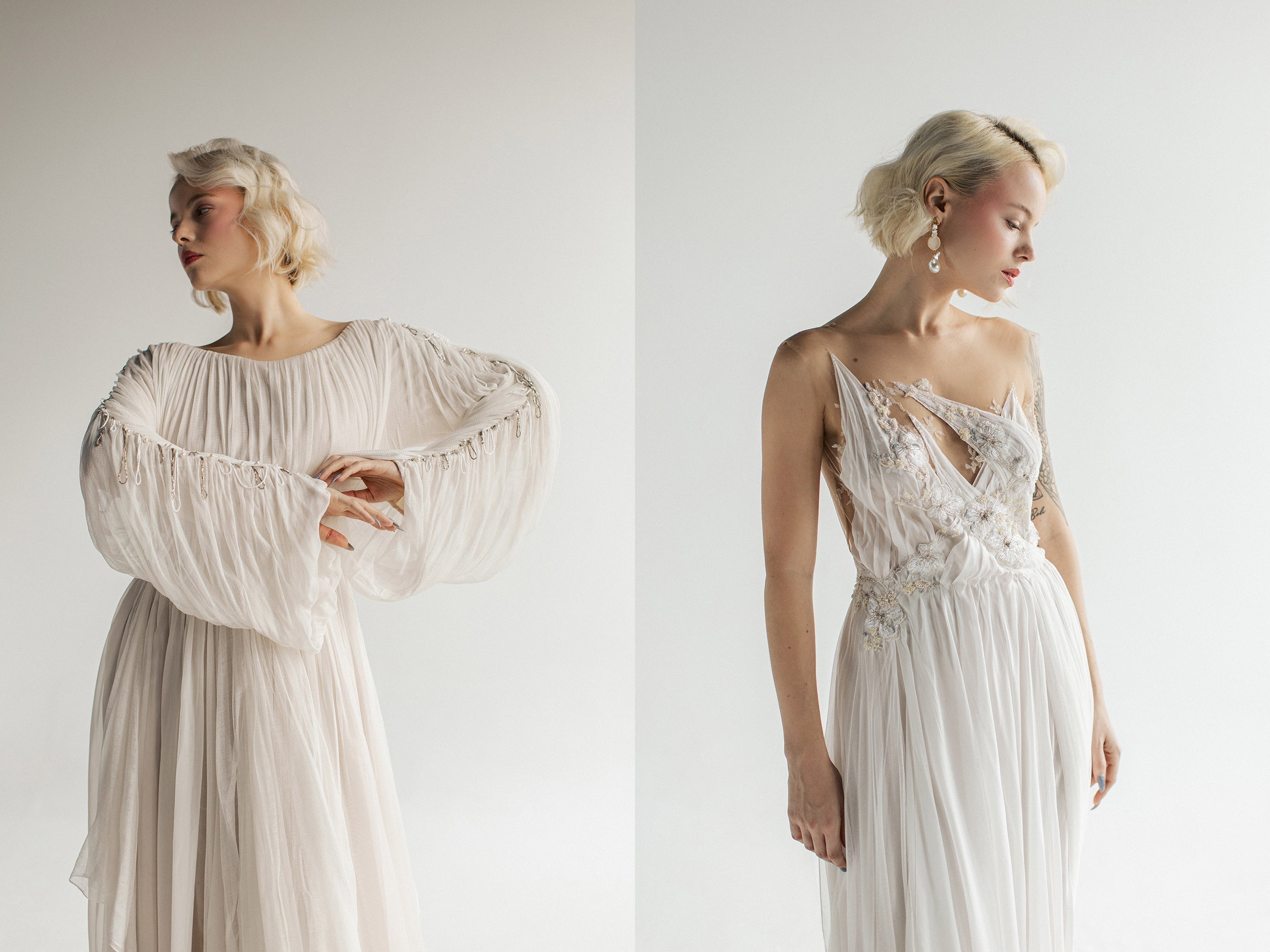
There are about a dozen core wedding dress silhouettes, and a further half-dozen variations within each one. If the vocabulary feels overwhelming at first, remember that every dress in every atelier traces back to one of these shapes. Once you know the names you will see them everywhere — and the search for your dress becomes much less about scrolling and much more about choosing. Where the gowns shown throughout this guide come from our couture collections, each is hand-finished in natural silk and cut to the bride's own measurements; silhouette is only the beginning of what makes a Mýwony gown.
How to read this chart
A wedding dress silhouette is defined almost entirely by three things: where the waist sits, how close the skirt is to the body, and how the shape flares (or doesn't). Everything else — neckline, sleeve, fabric, train, color — is layered on top of that foundation. If you keep these three variables in mind, you can read any gown at a glance.
- Waist placement — natural, empire (just below the bust), drop-waist, or basque (pointed, below the natural waist)
- Skirt fit — fitted, fluid, voluminous, or tiered
- Silhouette shape — A-line (flares out gently), sheath (straight column), ball gown (dramatic flare), mermaid (fitted to the knee then flares), trumpet (fitted to mid-thigh then flares), empire (falls from bust)
The wedding dress styles chart at a glance
A quick reference before the deep dive. Each silhouette is explained in detail below, with a Mýwony gown you can study as a real-world example. Difficulty levels for "fit flexibility" are our own assessment of how forgiving the silhouette is across body types.
| Silhouette | Shape in one line | Best for | Fit flexibility | Mýwony example |
|---|---|---|---|---|
| A-line | Fitted bodice flares gently from the waist | Most bodies, most venues | High | Lavinia |
| Ball gown | Fitted bodice, dramatically full skirt | Hourglass / rectangle; formal venues | Medium | Calypso Nightfall |
| Mermaid | Hugs the body from bust to knee, then flares | Hourglass & pear; dramatic venues | Low | Phaeno, Silent Waterfall |
| Trumpet | Hugs to mid-thigh, then flares softly | Hourglass, tall, long-torso | Medium | Ophelia, November |
| Sheath / Column | Straight fall from shoulder to hem | Long, lean; minimalist venues | Medium | Cressida, Portia |
| Slip | Bias-cut, liquid, body-skimming | Long, lean, hourglass | Low | Rhiannon |
| Empire | Waist just below the bust, fluid skirt | Petite, pear, apple; outdoor venues | High | Titania, Aine, Maia |
| Grecian | Empire + soft pleats or asymmetric drape | Most bodies; destination weddings | High | Titania, Brighid, Amalthea |
| Tiered / Layered | Multiple horizontal layers from waist to hem | Curvier figures; outdoor, garden, boho | High | Sironna |
| Fit-and-flare | Natural waist, soft A-line skirt (between A-line and trumpet) | Most bodies | High | Aine, Sironna |
| Tea-length | Any silhouette cropped to mid-calf | Courthouse, destination, reception | High | — |
| Mini / Short | Any silhouette above the knee | Reception, afterparty, elopement | Medium | Silver Mist |
| Two-piece / Separates | Top + skirt as distinct pieces | Destination, custom-loving brides | High | Peony skirt, Calypso Daylight |
The twelve silhouettes, in depth
1. The A-line
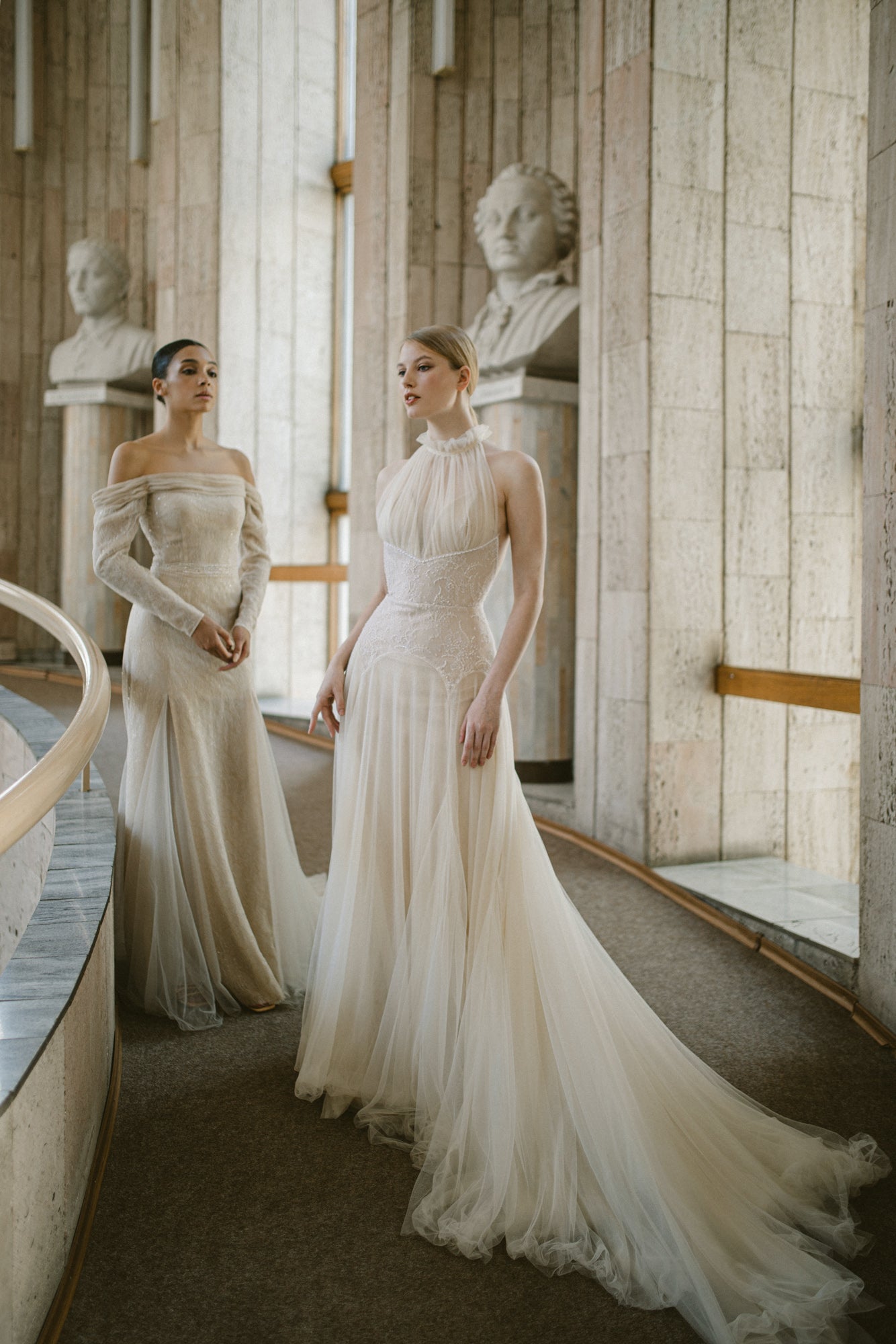
The A-line is the workhorse of wedding dress design and the most flattering silhouette on the widest range of bodies. It is softly fitted through the bodice, meets the waist at the natural waistline (or slightly above), and releases into a gentle, continuous flare that falls all the way to the hem — tracing the shape of a capital letter A.
The A-line works in almost every fabric (lace, silk, tulle, cotton, organza), almost every venue (garden, church, ballroom, barn), and with almost every neckline and sleeve choice. It photographs cleanly from every angle, moves gracefully without being voluminous, and requires minimal structural boning, which makes it comfortable to wear for a long day. If you are unsure where to start, you start here.
Best for: most body types, especially pear and apple shapes; weddings in any setting.
Watch for: petite brides should make sure the flare starts at the true waist, not below; too low a flare shortens the legs.
2. The ball gown

The ball gown is the most formal and most architecturally dramatic silhouette in bridal. A fitted bodice meets a voluminous, full skirt that flares out at the natural waist and falls to the floor in a sweeping cascade. It is the silhouette of princess weddings, ballroom receptions, and cathedral ceremonies.
A ball gown does two things at once: it creates visual drama (no other silhouette announces wedding quite so clearly) and it flatters the waist by contrast, making the torso look smaller in relation to the skirt. In 2026, the modern ball gown is usually softer and less boned than the ball gowns of the 1990s and 2000s — the volume is created with layers of tulle or silk rather than heavy crinoline.
Best for: hourglass and rectangle figures; formal indoor venues with space for the skirt.
Watch for: ball gowns do not travel well and are difficult to wear on grass or sand. They also need a reception you can move in — consider a second, lighter look for dancing.
3. The mermaid

The mermaid silhouette hugs the body closely from the bust to the knee, then flares out dramatically below the knee in a trumpet of fabric that sweeps to the floor. It is perhaps the most overtly sculptural of bridal shapes, designed to display and emphasize curves.
Mermaid gowns work best on bodies that have the curves to fill them — hourglass and pear figures in particular — and on brides who want a dress that is unmistakably, theatrically formal. They photograph beautifully, especially from the back, and read as modern when cut in minimalist, matte fabrics (silk crêpe, silk crash chiffon, matte lace) rather than crystalline beaded ones. Our Phaeno is a fully-couture interpretation in translucent ivory mesh and tulle, with a slim-fitted hip and an asymmetric boat-to-V neckline; the Silent Waterfall is the more romantic version, with an ivory French lace bodice and a soft tulle mermaid skirt over a blush-nude lining.
Best for: hourglass and pear figures; dramatic venues; brides who want the dress to be the centerpiece.
Watch for: sitting, dancing, and climbing stairs in a traditional mermaid is difficult — consider a trumpet cut (see below) for more freedom of movement.
4. The trumpet

The trumpet is the mermaid's slightly more wearable sister. It hugs the body closely through the bust and hips, but releases into its flare higher — usually at mid-thigh — creating a softer bell of fabric below rather than a sharp flare at the knee. The silhouette keeps most of the drama of the mermaid but allows meaningfully more freedom to walk, sit, and dance.
A trumpet is often the right choice for brides who love the mermaid silhouette but want to actually enjoy their reception. It also photographs as slightly less overtly sexual than a true mermaid, which some brides prefer. The Mýwony Ophelia is a good example: the fit is close through the torso, then softens into movement below mid-thigh. The November is a more romantic trumpet — off-shoulder scalloped neckline in French lace with beaded embroidery on a soft tulle skirt and an extended train.
Best for: hourglass, tall, and long-torso figures; ceremonies that ask for drama; receptions that ask for movement.
Watch for: like the mermaid, trumpet gowns benefit from careful alterations; the fit at the knee is the make-or-break detail.
5. The sheath (column)

A sheath — sometimes called a column gown — falls in an almost perfectly straight line from the shoulder to the hem. There is no flare, no gathering, no volume; the fabric simply traces the vertical line of the body. Sheaths are the most architecturally minimalist bridal silhouette and the closest cousin of the slip.
Sheaths work best in fabrics that hang beautifully from their own weight: silk satin, silk crêpe, silk charmeuse, heavier lace. They are especially effective for city-hall weddings, modern museum or rooftop venues, and brides whose personal style leans toward the refined and the minimal. A well-cut sheath is one of the most expensive-looking silhouettes in bridal, even in the simplest fabric. The Mýwony Cressida is a hand-finished sheath in natural silk satin with volumetric illusion sleeves and asymmetric beading at the back; the Portia is the bohemian sister — a natural-silk column with a V-neckline, long kimono sleeves, and chiffon inserts down the skirt.
Best for: long, lean, and rectangular figures; modern, minimalist venues.
Watch for: sheaths emphasize vertical lines and reveal every curve. The fit must be perfect — this is not a silhouette that tolerates off-the-rack shortcuts.
6. The slip
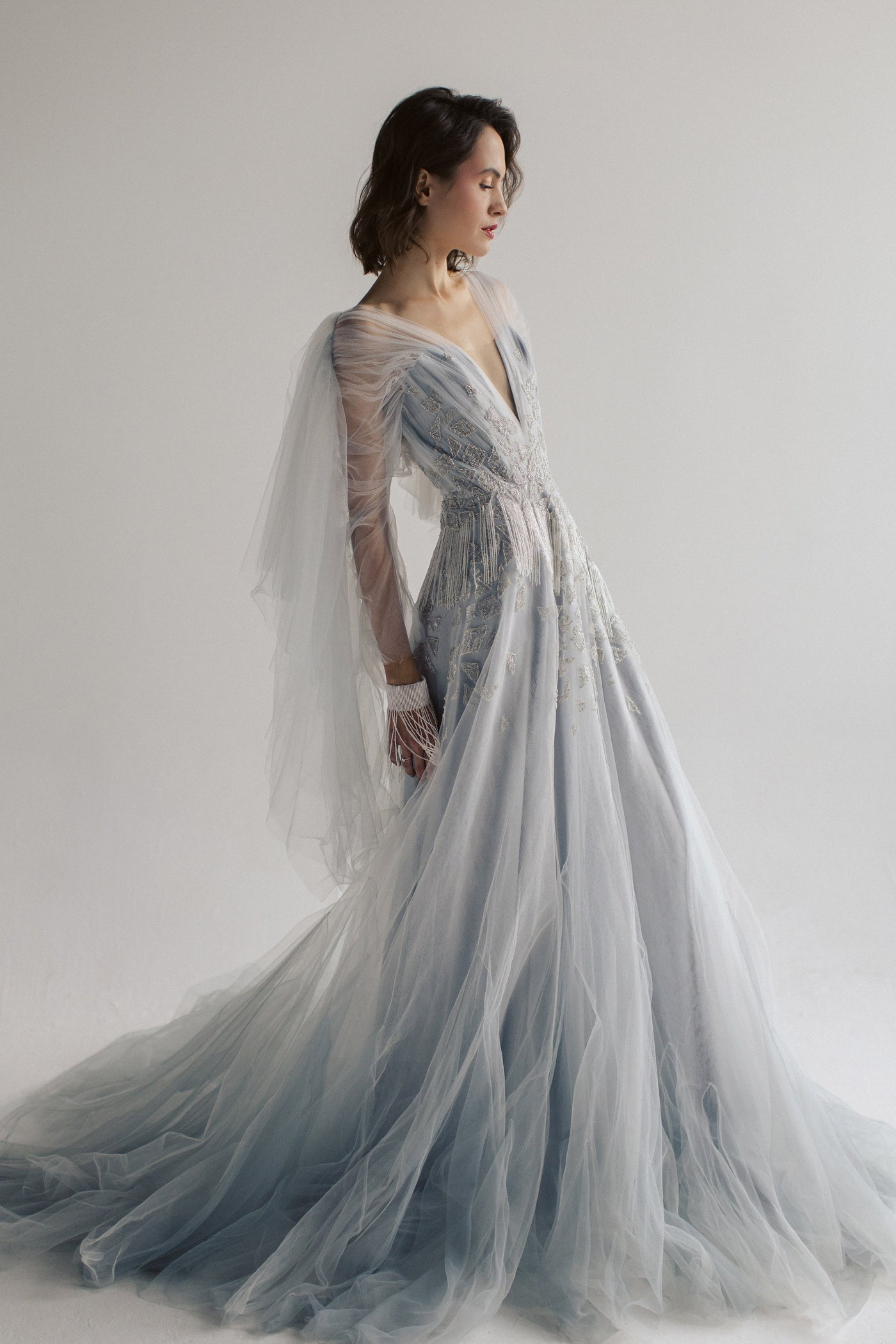
The slip gown is the sheath's softer, more romantic relative. It is usually cut on the bias, which allows the fabric to flow diagonally across the body and hang with a fluid, almost liquid quality. Slips are traditionally made in silk charmeuse, silk crêpe de chine, or silk satin — the softness of the fabric is essential to the silhouette.
The slip is the silhouette of 1990s Calvin Klein minimalism, of Carolyn Bessette-Kennedy, and of the quietly-luxurious bridal movement of the last several years. It is deeply flattering on long, lean, and hourglass figures, and it also happens to be one of the most comfortable gowns to wear for an entire wedding day. Our Rhiannon is a classic silk slip; for a two-piece variation, see the Peony skirt.
Best for: long, lean, and hourglass figures; minimalist, beach, and modern venues.
Watch for: slips reveal lingerie lines and any structural shapewear — plan your under-layers carefully.
7. The empire

An empire-waist gown has a waistline that sits just below the bust, with the fabric releasing into a gentle fall from that point all the way to the hem. The silhouette has a heritage that reaches back to Regency-era gowns and, further, to the draped garments of classical antiquity.
Empire silhouettes are among the most forgiving in bridal. Because the waist sits high and the skirt falls straight, they hide the midsection entirely, lengthen the legs, and flatter almost every body — including bodies that do not usually find flattering cuts in off-the-rack bridal. Empire gowns are also particularly lovely on pregnant brides and for destination weddings where structure would be impractical. Mýwony cuts the empire silhouette across several gowns: the Titania is the romantic version; the Aine is the classical ivory expression in soft draping; and the Maia is a maternity-friendly silk chiffon empire with floral pearl embroidery.
Best for: petite, pear, and apple figures; pregnant brides; destination, garden, and outdoor venues.
Watch for: the cut under the bust is critical — a poorly placed empire waistline can flatten the chest or emphasize the wrong area.
8. The grecian
The grecian gown is, technically, an empire silhouette with soft pleats, asymmetric shoulder draping, or a single-shoulder strap that references the chiton of classical Greek dress. In practice it is usually categorized as its own style because the draping creates a distinctly softer, more flowing visual effect than a simple empire line.
Grecian gowns are the most flattering choice for brides who want an empire's ease with more visual interest — the pleating gives the eye somewhere to travel. Like empire silhouettes, grecians are also exceptionally comfortable and suited to destination weddings. The Titania is cut with grecian sensibilities; the Brighid from our 2024 collection is a clean ivory grecian; and the Amalthea is the most sculptural — a hand-draped silk chiffon bodice with a V-shape front and back over a softly gathered silk chiffon skirt fully lined in silk charmeuse.
Best for: most body types; destination, garden, and beach venues; warm months.
Watch for: the draping must be in high-quality silk or silk georgette — cheaper fabric will not hold the pleats cleanly.
9. The tiered (layered) skirt
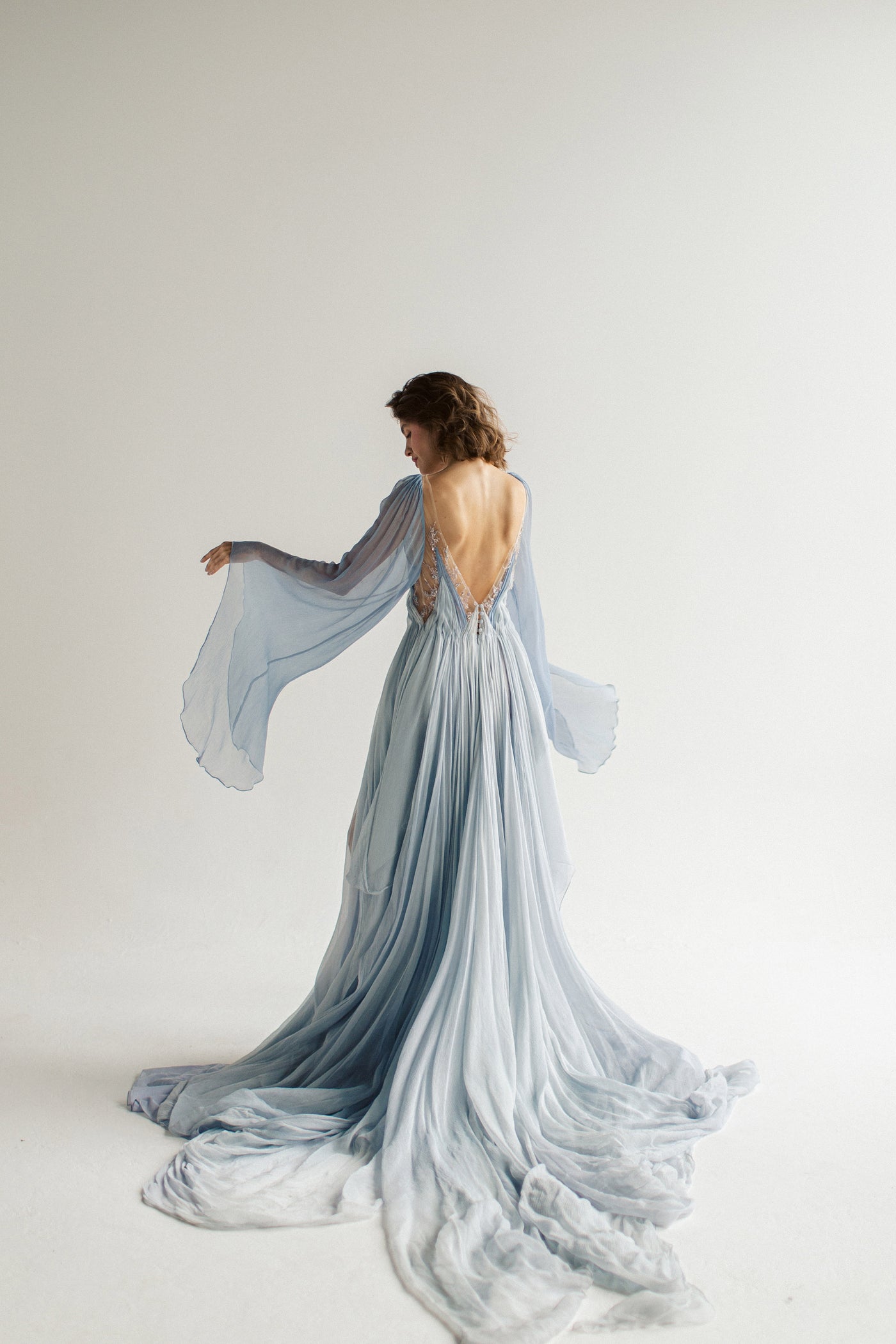
A tiered or layered gown builds its skirt out of multiple horizontal bands of fabric stacked from waist to hem. Each tier can be gathered, ruffled, or handkerchief-cut; the cumulative effect is volume without the weight or formality of a ball gown, and movement that is impossible to achieve in a single-panel skirt.
Tiered gowns are especially at home in bohemian, garden, and outdoor wedding contexts, where their movement can breathe. They are also particularly flattering on curvier figures, since the horizontal lines create definition at the waist. The Mýwony Sironna is our signature take.
Best for: curvier figures; bohemian, garden, and outdoor weddings.
Watch for: tiered skirts can overwhelm petite frames — look for variations with fewer, wider tiers if you are under 5'4".
10. The fit-and-flare
The fit-and-flare sits between the A-line and the trumpet. The bodice is more fitted than an A-line (usually through the natural waist and hip), and the skirt flares softly below the hip rather than at the waist. The silhouette creates a slight hourglass curve without the drama of a mermaid or the volume of a ball gown.
Fit-and-flare is perhaps the most generally flattering silhouette for brides who want a defined waist without committing to a fully fitted mermaid or trumpet. It also photographs particularly well in motion, since the flare catches the light and movement without overwhelming the frame. The Mýwony Aine reads as a refined fit-and-flare when the empire waist is taken in slightly; the Sironna brings the silhouette into bohemian territory with its soft tiered movement at the hem.
Best for: most body types, especially hourglass and pear; semi-formal to formal venues.
Watch for: the term "fit-and-flare" is used loosely in the industry — always check the exact fit on the hip, which is what distinguishes it from a simple A-line.
11. Tea-length, midi, and mini

Tea-length, midi, and mini gowns are not, strictly speaking, their own silhouette — any silhouette (A-line, sheath, tiered) can be cut shorter. But because the hemline so radically changes the feel of the gown, short dresses are usually considered their own category.
Tea-length (mid-calf), midi (just below the knee), and mini (above the knee) have become increasingly common for courthouse ceremonies, destination and beach weddings, second-look reception dresses, and brides who simply prefer a hemline that lets them move. They work best in soft silhouettes (A-line, fit-and-flare, slip) and in fabrics that read unmistakably bridal — silk crêpe, embroidered tulle, or fine lace. The Mýwony Silver Mist, cut in silver-grey natural silk with a halter neckline and deep open back, is a couture take on the short silhouette — designed as a bridesmaid dress but increasingly chosen as a reception second look or for a civil ceremony.
Best for: courthouse, destination, reception dresses, elopements.
Watch for: shoe choice is proportionally more visible in a short dress; the shoes become part of the overall silhouette.
12. Two-piece and separates

A two-piece (or separates) bridal look pairs a fitted lace or beaded top with a separate skirt, treating the pieces as distinct rather than a single unified gown. It is the most flexible approach in bridal: one top can pair with multiple skirts, the pieces can travel separately for destination weddings, and the seam between them becomes a design feature rather than something to hide.
The two-piece is also one of the defining structural trends of 2026. Our flagship two-piece is the Laetisse from Spells of the Whispering Forest — an off-shoulder silk crash chiffon blouse worn over a beaded tulle skirt with hand-stitched silk flowers at the hem. The Miryelle from the same collection is offered as a full gown or as separates (silk top, lace top, silk skirt) that can be combined in different ways across a wedding day. The Mýwony Peony skirt is an explicit separate, made to be paired with any lace top in the collection, and the Calypso Daylight pairs a sleeveless top with a champagne volumetric tulle skirt over ivory satin — a daylight-romantic counterpart to the more dramatic Calypso Nightfall.

Best for: destination weddings; brides who want flexibility; personalized, mix-and-match looks.
Watch for: both pieces must be fitted together — the seam line is what makes or breaks the look.
Wedding dress waist styles, in brief
Closely related to silhouette is the waist style of a gown — which is technically where the bodice meets the skirt, but is really the single most important design decision in any wedding dress. Four waist styles dominate bridal.
- Natural waist — sits at the smallest part of the torso, usually an inch or two above the navel. The most universally flattering waist placement and the default for A-line, ball gown, trumpet, and fit-and-flare silhouettes.
- Empire waist — sits just below the bust. Used in empire, grecian, and some A-line silhouettes. Flattering on petite, pear, apple, and pregnant brides.
- Drop waist — sits at or below the hip bone. Used in mermaid, some sheath, and increasingly in 2026's revival silhouettes. Best on long-torso and hourglass figures.
- Basque waist — dips into a V below the natural waist before flaring. Distinctly vintage (1920s, 1990s) and enjoying a 2026 revival. Deeply flattering on hourglass figures.
Which wedding dress silhouette suits your body type?
These are guidelines rather than rules — the silhouette you feel most beautiful in always wins over any chart. But if you are starting your search and want a baseline, here is where we would send you first.
| Body type | Most flattering silhouettes | Also try | Approach with care |
|---|---|---|---|
|
Hourglass (balanced bust, waist, hip) |
Mermaid, trumpet, fit-and-flare, slip | A-line, ball gown, sheath | Loose empire |
|
Pear (smaller bust, fuller hip) |
A-line, ball gown, empire | Fit-and-flare, grecian | Mermaid, trumpet, sheath |
|
Apple (fuller midsection) |
Empire, A-line, grecian, tiered | Fit-and-flare | Mermaid, slip, sheath, drop-waist |
|
Rectangle (straight, athletic) |
Ball gown, mermaid, tiered, fit-and-flare | A-line with defined waist, basque | Sheath (can read boxy), slip |
|
Petite (under 5'4") |
A-line, empire, sheath, slip, tea-length | Fit-and-flare, grecian | Heavy ball gown, multi-tier, long train |
| Tall & long-torso | Drop-waist, basque, trumpet, mermaid, sheath, slip | A-line, ball gown, fit-and-flare | Empire (shortens torso visually) |
Silhouette by venue — a quick guide
The setting of your ceremony should influence silhouette as much as your body type does. We covered this in more detail in our Ultimate Guide to Bohemian Wedding Dresses, but here is the short version.
- Garden or meadow: A-line, empire, tiered, grecian
- Beach or seaside: Slip, sheath, grecian, tea-length
- Forest or woodland: A-line, empire, tiered
- Barn or rustic: A-line, fit-and-flare, two-piece
- City or minimalist: Slip, sheath, A-line
- Ballroom or cathedral: Ball gown, mermaid, trumpet
- Courthouse or civil: Tea-length, slip, sheath, mini
- Destination: Slip, two-piece, grecian, empire
Frequently asked questions
What is the most popular wedding dress style?
The A-line is consistently the most popular wedding dress silhouette because it is the most universally flattering — it works on almost every body type, almost every venue, and in almost every fabric. It is the safe, timeless, and most-requested silhouette in bridal. Slip gowns, fit-and-flare, and ball gowns are also among the top four most-chosen silhouettes in 2026.
What is the most flattering wedding dress silhouette?
There is no single most-flattering silhouette — it depends on body type. In general, the A-line flatters the widest range of bodies because it skims the torso and flares gently from the waist. Empire and grecian silhouettes are especially flattering on petite, pear, and apple figures. Mermaid and fit-and-flare silhouettes are most flattering on hourglass figures. The silhouette that flatters you best is one that defines your waist (natural, empire, or basque), skims rather than clings to areas you prefer not to emphasize, and leaves you comfortable enough to move through a long wedding day.
What is the difference between an A-line and a ball gown?
Both silhouettes have fitted bodices that flare into a full skirt, but the flare is radically different. An A-line flares gently from the waist to the hem in a continuous line — tracing the shape of the letter A. A ball gown flares dramatically at the waist into a voluminous, often multi-layered skirt that is significantly fuller than an A-line. Ball gowns are more formal and more structured; A-lines are softer, more versatile, and more wearable in a range of venues. If you could only own one wedding dress silhouette, most stylists would recommend an A-line; if you want pure fairy-tale drama, choose a ball gown.
What is the difference between mermaid and trumpet wedding dresses?
Both silhouettes hug the body closely before flaring into a bell of fabric, but the flare point is different. A mermaid flares below the knee, creating a dramatic trumpet of fabric very close to the floor. A trumpet flares higher — usually at mid-thigh — which gives the bride significantly more freedom to walk, sit, and dance. The trumpet is considered the more wearable of the two silhouettes; the mermaid is considered the more dramatic. Both are most flattering on hourglass and pear figures.
What is a basque waist on a wedding dress?
A basque waist is a waistline that dips below the natural waist into a V or pointed shape before flaring into the skirt. It is a vintage silhouette with roots in 19th-century dress and 1920s bridal, and it is experiencing a major revival in 2026. Basque waists are deeply flattering on hourglass figures because they emphasize and elongate the waist at the same time. They are most commonly paired with A-line, ball gown, and fit-and-flare skirts.
What wedding dress silhouette is most flattering for plus-size brides?
A-line, empire, tiered, and fit-and-flare silhouettes are generally the most flattering on fuller figures because they skim the body rather than clinging to it and they define the waist without restricting the midsection. Empire silhouettes in particular are exceptionally forgiving across the midsection. Mermaid and trumpet silhouettes can also be stunning on curvier bodies, but require more careful fitting and alterations to be truly flattering. Look for boutiques that offer made-to-measure or extended sizing — fit is far more important than silhouette for a plus-size wedding dress.
How do I choose the right wedding dress silhouette?
Three steps. First, try on each of the main silhouettes (A-line, ball gown, mermaid or trumpet, sheath or slip, empire) at a bridal boutique, ideally in the fabrics and colors you might actually choose. The silhouette that feels most like you in a dressing room will nearly always be the right answer. Second, consider your venue — some silhouettes work better in certain settings (a ball gown in a garden will drag; a slip gown in a cathedral may feel underdressed). Third, consider your body type — but only as one factor among several, and only after you have tried the silhouettes in person.
What is the difference between fit-and-flare and A-line?
A fit-and-flare is more fitted through the hip before it flares; an A-line flares from the natural waist in a continuous, unbroken line. A fit-and-flare creates a slight hourglass shape through the hip and is most flattering on hourglass and pear figures; an A-line hides the hip entirely and is more universally flattering. The two silhouettes are often used interchangeably in bridal marketing, so always look at the actual hip fit on the gown to tell them apart.
Explore Mýwony silhouettes
If reading about silhouettes has given you a sense of which shapes you want to try on, the best next step is to see them on a hanger and in the light. Our current couture collection, Spells of the Whispering Forest, covers nearly every silhouette discussed above in natural silks and hand-applied detail. You can also browse the full Mýwony collection or the 2024 collection; for a more complete view of the bohemian end of our aesthetic, read our full bohemian wedding dress guide or the 2026 trend report. And when you are ready for a fitting, start with our measurement guide — it will save you time at the first appointment.